

What is a USB security key, and how do you use it?
What is a USB security central, and how do you lot use information technology?
Few things are more important than protecting your personal data online, but doing then is not e'er as easy equally it sounds.
Certain, making up strong and varied passwords for each of your online accounts is a first, and two-factor hallmark (2FA) can certainly make things considerably more secure. But nothing is perfect, and the mostly widely used 2FA options, including texted codes and authenticator apps, tin yet issue in unexpected business relationship takeovers.
- You lot're probably doing 2FA wrong: Here's the correct way
- The best password managers to protect your online accounts
So how tin you lot farther improve your online security? The answer is to use a portable security key, as well known equally a USB security cardinal or a hardware security primal, as your second 2FA cistron.
These small and discreet keys tin can exist attached to a keychain, kept in a pocket or left plugged into a laptop, and they'll provide you with an actress layer of comfort and security. Microsoft fifty-fifty lets y'all supervene upon your password with a USB security key.
In this guide, we're going to look at hardware security keys, their costs, which brands are offered and how to apply them so that you lot can make an informed decision about which 1 is all-time for you.
What are USB security keys?
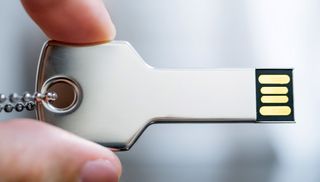
Security keys look similar small USB drives and can be plugged into a wide collection of devices. Some are and so small that they barely stick out when plugged into a laptop. Thanks to a fleck inside that contains codes and protocols, each ane of these physical keys can connect to online servers to verify that you are the person accessing whatever device y'all've plugged information technology into.
Though they're near typically plugged into a computer'south USB-A or USB-C port, some security keys feature wireless Bluetooth or NFC capabilities to connect to mobile devices too. A couple have Lightning plugs to connect to iPhones and older iPads.
How USB security keys fit into ii-factor authentication
Though a USB security key may sound redundant on paper, information technology brings major benefits. Here are some things to consider.
Passwords are easier to figure out than you'd think. Not just practise many people use weak or like passwords for every account, but advanced algorithms and powerful computers can effigy out many "potent" passwords with enough fourth dimension and try.
Furthermore, if you reuse the passwords and usernames on multiple sites, you multiply the risk that those login credentials will be exposed in a data breach. It doesn't matter how strong your countersign is if hackers can use "credential stuffing" to find other accounts where yous utilize it. One data breach could result in many accounts beingness hijacked, even months or years later.
Aside from never reusing passwords, the best way to protect an online account is to use 2FA. When you log into a website from a new figurer or mobile device, the login page will ask you to enter a second hugger-mugger "factor" along with your countersign.
This factor is often a one-time passcode (OTP) sent to your phone via text message, electronic mail, "push" notification or voice call. Authenticator apps can also generate one-fourth dimension passcodes for each account. The thought is that a hacker who has your password won't take your smartphone and thus tin can't receive or generate the right one-time passcode.
Enter the passcode into the login page, and y'all're in. Yous tin ask the site to "recognize" your new device and so that y'all won't need to get through the 2FA process next time yous log into the account.
Why practise I need a hardware security key?
Even so phone-based 2FA isn't foolproof. Hackers can intercept texted codes by "porting" your phone number to another device or having your e-mail messages secretly forwarded. Authenticator-app OTP codes can be "phished" past tricking the user into entering them into phony websites.
Hardware security keys provide the toughest 2FA factor available. They don't depend on any devices likewise themselves. They are an exclusive access point; no one can access your data unless they have both your password and your concrete security central.
A USB security fundamental is an intelligent trivial device that recognizes websites, and because of this, it will end you from entering information on a phishing site out to steal your passwords.
How would I use a USB security key?
Setting up a hardware security key is easy: Log into your website of pick and brand sure 2FA is enabled and set up up. It's OK if y'all've already ready up 2FA to piece of work with texted codes or an authenticator app.
Discover the function in the settings page that lets you add more factors to your 2FA enrollment. Click to add a new gene and see if there's annihilation that resembles "USB Security Central," "External Security Cardinal" or the like.
If so, click it and follow the instructions. Some sites, like Facebook, want yous to insert the key into your computer's USB port right away. Others, like Google, want you lot to fill up out a couple of more things first.
One time y'all plug the key in, the website volition read it and ask you to requite it a name. If you're on a contempo version of Windows 10 or Windows 11, Windows may ask you lot to add a passcode to the key as well.
From here on, you lot can utilise the USB security central equally the 2nd gene for any website on which the central is registered. For some sites, the cardinal will go the default 2FA method. Other sites let you rank 2FA methods in society of priority.
Which websites support hardware security keys?
Most major websites and organizations support the near basic FIDO/U2F and FIDO2/WebAuthn security-key standards, including Dropbox, Facebook, Google, Microsoft, Twitter, Yahoo and YouTube, plus the password managers BitWarden, Dashlane, Keeper and 1Password.
For some other sites, you lot'll need more advanced (and more than expensive) keys, such as Yubico's YubiKey serial (except for the YubiKey Bio, which is U2F/WebAuthn only). These sites include, LastPass, Tesla and Twitch. Y'all can also log into a computer using a YubiKey.
All major browsers support USB security keys, including Dauntless, Chrome, Edge, Opera and Safari.
What are the downsides of a USB security key?
There are some potential drawbacks to using a hardware security key.
Beginning of all, you could lose it. While security keys provide a substantial increase in security, they also provide a substantial increment in responsibleness. Losing a security key can issue in a serious headache.
Nearly major websites suggest that you set fill-in 2FA methods when enrolling a USB security key, but there's always a small but real chance that y'all could permanently lose admission to a specific account if you lose your central. Security-key makers propose buying more than one key to avert this situation, but that can chop-chop go expensive.
Cost is another issue. A hardware security central is the merely major 2FA method for which you accept to spend money. You tin get a basic U2F/WebAuthn security central standards for $15, but some websites and workplaces require specialized protocols for which compatible keys can price up to $85 each.
Finally, express usability is also a factor. Not every site supports USB security keys. If you're hoping to use a security key on every site for which you take an account, you're guaranteed to come across at to the lowest degree a few that won't accept your security key.
Which hardware security central is right for me?
There are a scattering of of import things to consider when deciding on which USB security central is best for you.
Prices for hardware security keys more often than not range between $15 and $60, and while fifty-fifty lower-end keys can be useful for simple protection, yous practise tend to go what you pay for in nearly cases.
The pricier options might include capabilities missing in the cheaper alternatives, such as NFC, Bluetooth, and higher durability — all of which could be very important if you'll be using the key in a variety of situations.
The trickier function of buying a USB security central is figuring out which hallmark standard you need. Almost all security keys support FIDO/U2F and its successor FIDO2/WebAuthn. These are usable on virtually major sites, such as Google, YouTube, Twitter, Microsoft, Nintendo, Reddit and many more than.
Yet, some websites and services, including LastPass, Tesla and many authorities accounts, require the additional standards.
If you can beget 1, information technology'south never a bad idea to pick up a hardware security key that supports multiple standards to ensure you run into fewer problems.
Here are some pop USB security keys that should fit the needs of nigh consumers:
Yubico YubiKey v NFC is the most popular hardware security primal for a practiced reason. Sporting a price tag of around $45, this key is small, durable, waterproof and supports NFC. It'due south just USB-A out of the box, merely a USB-C adapter can fix that small-scale quibble (or you can become the $55 YubiKey 5C NFC). It also ranks amidst the nigh compatible keys since information technology supports Yubico's proprietary algorithms as well equally other specialized protocols, which are required on certain sites similar LastPass.
Yubico YubiKey 5ci is for Apple tree-only consumers. The $lxx key combines a USB-C plug for Macs and newer iPads and a Lightning plus for iPhones and older iPads.
CryptoTrust OnlyKey can likewise be snagged for around $45, and it offers a few features that you won't find on many other hardware security keys. Most notably, it has a built-in password manager that tin can store your passwords securely or even generate strong ones for yous to use. The user interface tin can exist a little clunky, just for those with feel who want fifty-fifty more options, this one is dandy.
uQontrol Qkey Password Vault is amidst the virtually secure keys you tin purchase thanks to its war machine-grade hallmark. Dissimilar nearly keys, this one provides three-factor authentication using a security chip, a master password and a sensor that verifies the physical presence of its user. This one is a steal at only $30.
Google's Titan Security Central costs $30 and comes in either USB-C or USB-A formats. Both have NFC support to connect with smartphones every bit well. It supports U2F and WebAuthn.
Yubico FIDO Security Cardinal NFC is an inexpensive selection at effectually $25. Information technology'south made by leading make Yubico, but it's not a "Yubikey" since it lacks Yubico'due south proprietary algorithms alongside the standard U2F/WebAuthn algorithms. However, if you lot just demand a inexpensive key that has NFC support, this is a great grab and is $5 cheaper than Google's similar option.
SoloKey'due south most basic USB-A key is U2F only, and then there are some websites that won't support it, but you know what they say — you get what you pay for. In this case, though, $20 makes information technology a pretty solid deal for those on a upkeep or anyone simply looking for a decent backup central. Other Solo keys come with NFC and/or USB-C for a bit more than.

Source: https://www.tomsguide.com/news/usb-security-key
Posted by: rangelvers1976.blogspot.com
0 Response to "What is a USB security key, and how do you use it?"
Post a Comment